A safety management system, whether certified against ISO 45001, aligned with another reference standard, or built around the duties set by national legislation, rests on an architecture that no standard defines on its own: who answers for what, which requirements apply to each work context, where the evidence proving them is documented. That architecture is structural compliance. The choice of EHS software supporting it determines how coherent the management system stays when the organisation grows, integrates a site, or absorbs a legislative reform: a structure that does not update at the same speed as the business stops being a guarantee.
The architecture a management system requires, not the one a specific tool imposes
A management standard does not specify a software product. It specifies a structure, made of defined roles and responsibilities, requirements identified for each context, and documented information that stays accessible and current, and it leaves the organisation to sustain that structure over time. Directive 89/391/EEC follows the same logic for European employers: it sets the obligation and the general principles, and leaves the organisational form to each Member State and to each employer.
The distinction that matters during selection is between platforms that hold that structure as a general concept and platforms that hold it already bound to one specific regulation.
The temptation is to look for a tool that speaks the exact language of the current local regulation, with preconfigured modules and fixed statutory wording. It is an immediate comfort that produces a rigid architecture: when the organisation grows, opens a site, or faces a reform, the preset fields age, teams build manual workarounds or buy parallel systems, and the data fragments.
Some indicators of this approach: fields carrying a fixed regulatory reference; training categories tied to the hour structure of one national scheme; no way to bring findings collected under a different standard into a single overall assessment. These are legitimate design choices as long as the organisation stays inside the perimeter the software was built for, and they become a constraint the moment it moves beyond it.
The alternative is an architecture that models the universal concepts of safety (risk, inspection, training, role, asset, corrective action) and leaves the regulatory substance to configuration and data entry rather than to source code.
- Configurable naming. The software defines the structure; the organisation defines roles and nomenclature according to its own operating model.
- Replication of a site architecture. The setup of a configured plant is copied onto another one and adapted to local specifics. The benefit is not reserved to large groups: it applies to anyone who has to repeat the same setup often, from a contractor running several open sites to an industrial group with plants in different countries.
- Workflows that follow real processes. Approvals and matrices adapt to the way the organisation works, and not the other way around.
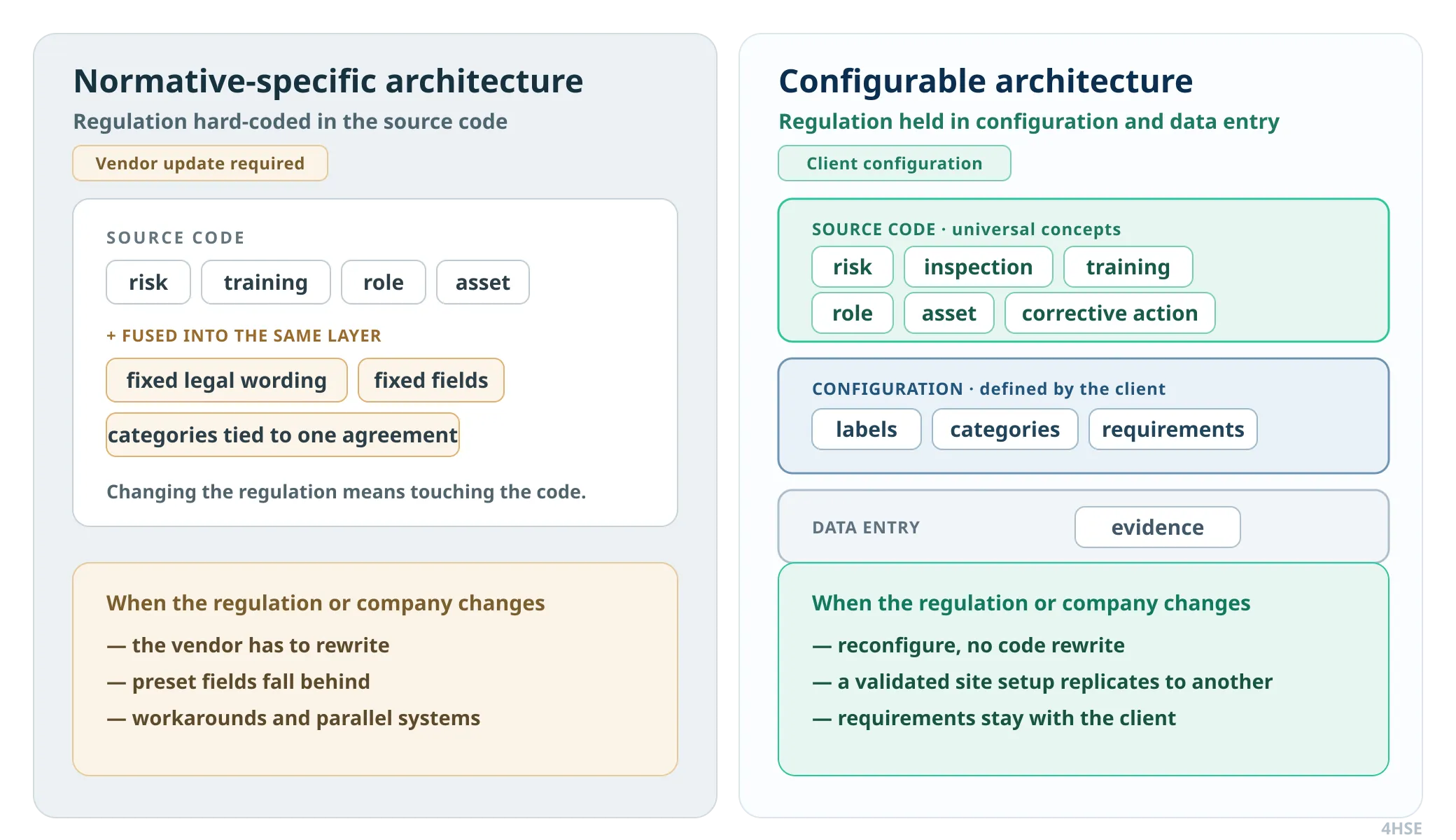
Regulatory agnosticism covers the border between one country and another, and also the way different organisations work inside the same rule: training categories, document formats, internal conventions for naming roles and responsibilities. A rigid architecture requires the client to adapt its processes to the software; a configurable one lets the client define them, as part of the model and not as exceptions handled outside the system.
The configurability that counts is the one on requirements, not the one on labels. The dimension along which requirements genuinely vary (task, role, shared exposure) is worth deciding upfront, because changing it once the model is populated means rebuilding the associations already made.
What it costs when the architecture does not hold
When a rigid architecture meets a context it was not designed for, the outcome is almost always one of these three, and none of them is cheap.
- Workarounds. A field meant for one content type gets reused for another, and someone maintains a separate mapping between what the software allows and what the work actually requires: the disorder the organisation wanted to leave behind, rebuilt inside the new tool.
- Parallel systems. A site or an acquired company adopts its own local tool because the central one does not fit. Two archives, two ways of reporting, no unified view.
- Paid customisation. The vendor adapts the platform through a consulting project. Every customisation requires maintenance at every subsequent release: the cost does not end at delivery.
In all three cases the organisation pays a tax on its own growth, and that tax rises with every site, every country, every reform the original architecture had not anticipated.
What structural compliance loses inside spreadsheets
If software rigidity is a trap for growth, running the structural layer on spreadsheets, shared files and paper folders is a risk for continuity. A spreadsheet represents the thinking of whoever built it: their priorities, their logic, their competence.
- Fragmentation. Every plant, and often every external consultant, builds a separate file. There is no single version of the data to decide on.
- Silent expiry. A missed re-inspection on a critical piece of equipment, or a supervisor whose training has lapsed, stays invisible until the audit or the event.
- Documented information without traceability. A management standard requires documented information to be identifiable, version-controlled and available to those entitled to it. A shared file without version control does not satisfy that requirement even when the data is correct: nobody can demonstrate which version was in force at a given moment.
- Accountability at the top. After an adverse event, the defence rests on a clear chain of delegations, appointments and assessments that can be produced immediately: the management model is demonstrated through the evidence documenting it.
Where structure meets execution
In management system terms this is the point where planning (Plan) meets implementation and checking (Do, Check), while the review of what has been detected (the Act of the cycle) returns the information to the model. Planning produces effects only when it connects to daily execution, in the lightest possible form for the people working in the field.
Task-oriented interfaces. A checklist for the activity underway, a quick near miss report, a permit to work verified on the spot. Interoperability, clarity and essentiality are what prevent the dispersion of effort, and therefore of information.
The return path from the field to the model. When the safety manager updates the requirements set for a job, the new activities appear for the workers concerned. When an inspection records a recurring non-conformity on one class of machinery, the signal reaches whoever can revise the maintenance plan or the requirements for that class of assets.
From detection to the decision on the remedy. The software brings the finding to whoever decides, with the necessary context: asset, history, evidence. The decision on additional measures and rescheduling stays with whoever answers for it: rescheduling a preventive action modifies the model, and the model is modified by choice.
Conclusions for evaluators
Choosing an HSE software platform for compliance is an architectural decision that weighs on the scalability of the business. Growing organisations, and organisations with a multi-site structure, find more room in platforms able to map the universal processes of safety through flexible configuration, replicating an already validated setup onto a new site.
Three checks worth running
Test the depth, not the word. Everyone claims to be configurable. Ask the vendor to create, during the demo, a requirement that does not exist yet and to associate it with a work context: how long it takes, and how it connects to known information, is worth more than any datasheet.
Ask for the invoice of growth. Ask what happens, in time and cost, when a new site opens, a country changes, or the rule changes. A new configuration or a new development contract: the answer separates an agnostic architecture from one that only claims to be.
Check that the return path closes the loop. A recurring anomaly detected in the field has to be able to change the requirements in force without manual data rebuilding. If a technical intervention is needed for that, the loop does not close.
How 4HSE supports the management system
4HSE can be used within a management system aligned with ISO 45001, ISO 9001 or other reference standards, national or international. It models the general concepts a management system requires (work context, requirement, owner, activity, deadline, evidence) and leaves the regulatory substance to configuration. Role names, document categories, types of preventive activity and document templates are defined in the platform: the same installation therefore works inside management systems built on different references, while the definition of the requirements stays with the client.
For multi-site growth, the setup of a configured site is replicated onto a new one and adapted to local specifics. Personnel records are imported from file, user accounts are unlimited and do not affect cost, and storage space has no limit.
Regulatory agnosticism translates, in practice, into an approach that can be called tailored: the platform imposes neither a single regulation nor a single methodology, and lets the client fit its own organisation, reference standards and internal conventions onto general concepts. For risk assessment, the native reference is the probability by severity methodology, while measurements carried out under other standards are attached and reported as values in that reference, so the management system stays single and integrated even when the assessment comes from different sources. Where native functionality reaches its limit, for a data exchange with a system already in use or a workflow involving applications outside the HSE domain, the documented REST APIs and the Zapier integration extend 4HSE beyond its native perimeter.
References and further reading
Institutional references
- ISO 45001:2018, Occupational health and safety management systems, requirements with guidance for use.
- ISO 37301:2021, Compliance management systems, requirements with guidance for use.
- ISO/IEC 27001:2022, Information security, cybersecurity and privacy protection, information security management systems.
- Directive 89/391/EEC, the European framework directive on the introduction of measures to encourage improvements in the safety and health of workers at work.
More on 4HSE