The question a site check really asks
A subcontractor arrives on site with a new crew. Ten workers, three hired last month. When the main contractor or a labour inspector stops one of them, reading the name on a document takes seconds. It also proves very little. The useful question runs deeper: is this person regularly employed, trained for this task, and authorised to work here, today?
Across Europe, the tools built to answer that question are known as social identity cards. A social ID card is a sector-specific credential that links a worker to an employer, and in the more advanced schemes to training records and qualifications, so that anyone responsible for the site can verify the essentials on the spot. Identity is the starting point. Authorisation is the real subject of the check.
A patchwork of national schemes
There is no single European card. According to the mapping report produced by AEIP for the SIDE-CIC project, 19 social ID card schemes operate across 17 countries of the European Economic Area, alongside local initiatives. Each scheme grew out of the same pressures: undeclared work, fragmented subcontracting chains, and a workforce that moves across borders faster than paper records do.
The national solutions differ in design. In Belgium, every construction blue-collar worker registered with the national social security office automatically receives a ConstruBadge, mandatory on site and required for posted workers as well. In Finland, since 2012, anyone working on a shared construction site must wear a photo ID showing a personal tax number listed in a public register; the Valtti card has become the standard way to meet that obligation. In Norway, the HSE card issued under the Labour Inspection Authority confirms that both the company and the worker appear in the required public registers.
What these cards actually verify
The differences matter more than the similarities. The Belgian and Norwegian cards primarily certify the employment relationship: the worker exists in the system, the employer is registered, the contract is real. The more evolved schemes go further. Finland’s Valtti card can be linked to a competence register, so completed safety training and professional qualifications can be read directly from the card. Spain’s Tarjeta Profesional de la Construcción, rooted in the sector’s collective agreement, records the occupational risk prevention training a worker has received.
Back to the crew at the gate. Knowing the welder’s name settles almost nothing. Knowing that the welder is employed by the subcontractor on the notification, and holds valid training for hot work, settles the question the site actually needs answered.
Toward interoperability: the EU direction
Could these national schemes talk to each other? The SIDE-CIC project, run by the European social partners EFBWW and FIEC and co-funded by the European Commission, examined exactly this. Its legal and technical feasibility studies concluded that interoperability between national schemes is achievable and would reduce fraud and administrative burden, though implementation remains complex. No EU-wide obligation exists today, and the project does not create one. What it does signal is a direction: the two federations now call on member states to further develop their card schemes and align them with each other. Digital verification, portable data, faster checks. The trajectory is clear even where the legislation is not.
Digital verification in practice
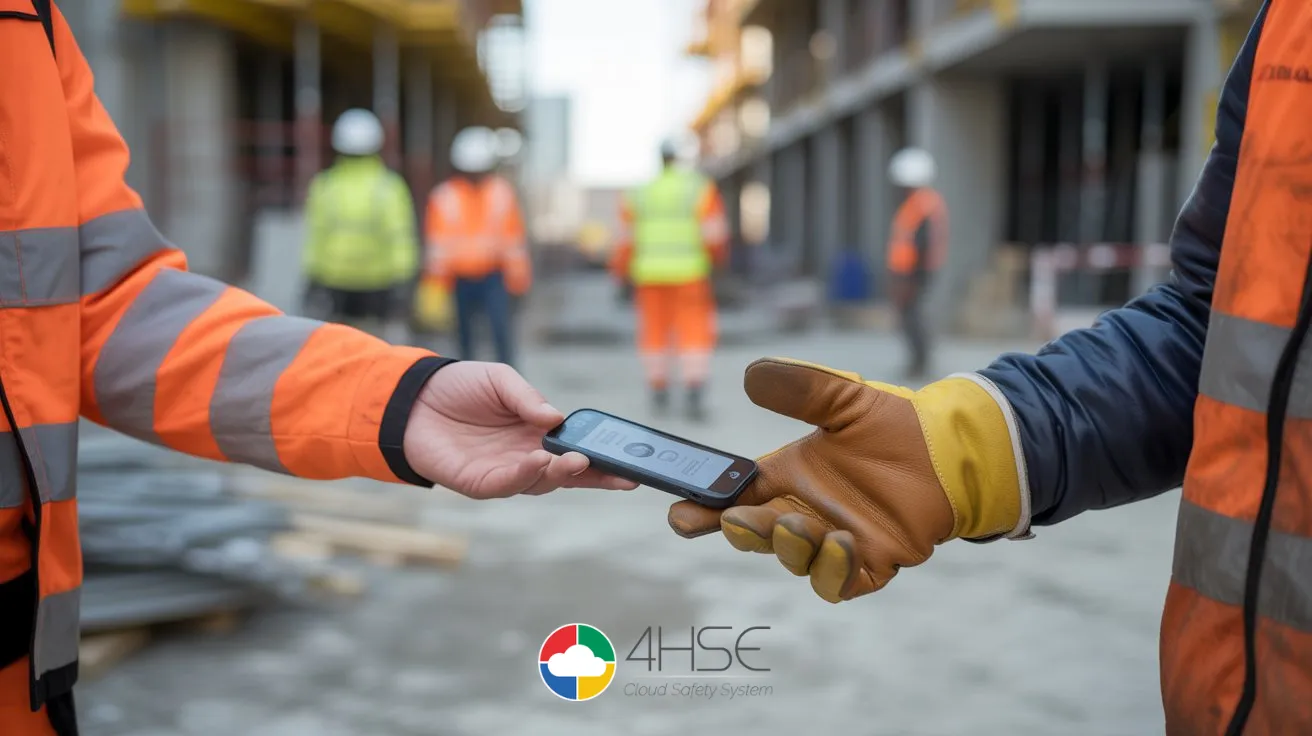
The same logic applies at the level of a single company. In 4HSE, every worker has a personal QR code that opens their profile: identity details, training status, valid certificates. Anyone on site can check it in seconds, with no account and no installation. The question a site check really asks gets its answer where the work happens.