Communication for Governance and Accountability
A structured system for user profiling and the distribution of notifications and periodic digests. The tool ensures real-time sharing of documents and deadlines between internal staff and suppliers.
- Transparent and Measurable Governance
- Granular profiling, HSE organization charts, and notification logic ensure that responsibilities are tracked and verifiable, reducing exposure and control costs.
- Low-Friction Operational Engagement
- Configurable notifications, periodic digests, and the mobile App keep recipients informed and operational, reducing response times and increasing compliance.
- Audit-Proof Communication
- System logs, activity reports, and documentary evidence guarantee the reconstructibility of processes and provide outputs immediately usable in inspections.
- Extended Collaboration and Scalable Governance
- Multi-project profiles and tools to involve suppliers and external collaborators allow governance to be extended to supply chains and external partners.
Operational sequence
4HSE's communication process for governance and accountability offers a comprehensive framework — from granular user profiling to targeted distribution of notifications and digests, to activity monitoring and reporting — that imposes order on information management. In 4HSE, this principle transforms the asset registry from a simple list into a structured database, ready to support risk assessment, scheduler population, and audit reporting.
-
Define Governance with Responsibilities and Functions
- Formalize the company organization chart and the HSE safety organization chart: define roles, appointments, and relative deadlines (HSE Manager, Safety Representative, emergency teams, site managers, and other customized roles).
- Formalize predefined roles (e.g., Training Coordinator, Maintenance Manager) and define micro-permissions to adapt visibility and actions at the project, site, operational area, or individual worker level.
- Establish special functions and roles for specific areas or activities and extend the management of area functions (training, PPE, procedures, medical visits and health surveillance, maintenance, events - NC, injuries, incidents, and near-misses).
- Formalize the company organization chart and the HSE safety organization chart: define roles, appointments, and relative deadlines (HSE Manager, Safety Representative, emergency teams, site managers, and other customized roles).
- Formalize predefined roles (e.g., Training Coordinator, Maintenance Manager) and define micro-permissions to adapt visibility and actions at the project, site, operational area, or individual worker level.
- Establish special functions and roles for specific areas or activities and extend the management of area functions (training, PPE, procedures, medical visits and health surveillance, maintenance, events - NC, injuries, incidents, and near-misses).
-
Profile Users
- Invite and register users: create accounts, assign to groups and profiles based on company classification and operational needs.
- Combine profiles for multi-company and multi-project scenarios: profiles that manage sites, operational areas, or individual workers with differentiated permissions.
- Configure default users and external profiles for suppliers/collaborators; define visibility and requirements for access to sensitive data.
- Document appointments and delegations; the system stores the history of changes for audits.
- Invite and register users: create accounts, assign to groups and profiles based on company classification and operational needs.
- Combine profiles for multi-company and multi-project scenarios: profiles that manage sites, operational areas, or individual workers with differentiated permissions.
- Configure default users and external profiles for suppliers/collaborators; define visibility and requirements for access to sensitive data.
- Document appointments and delegations; the system stores the history of changes for audits.
-
Communicate, Engage, and Inform for Maximum Accountability
- Schedule periodic digests and agendas: send reports and summaries to relevant functions (daily/weekly/monthly) with content adapted to the role.
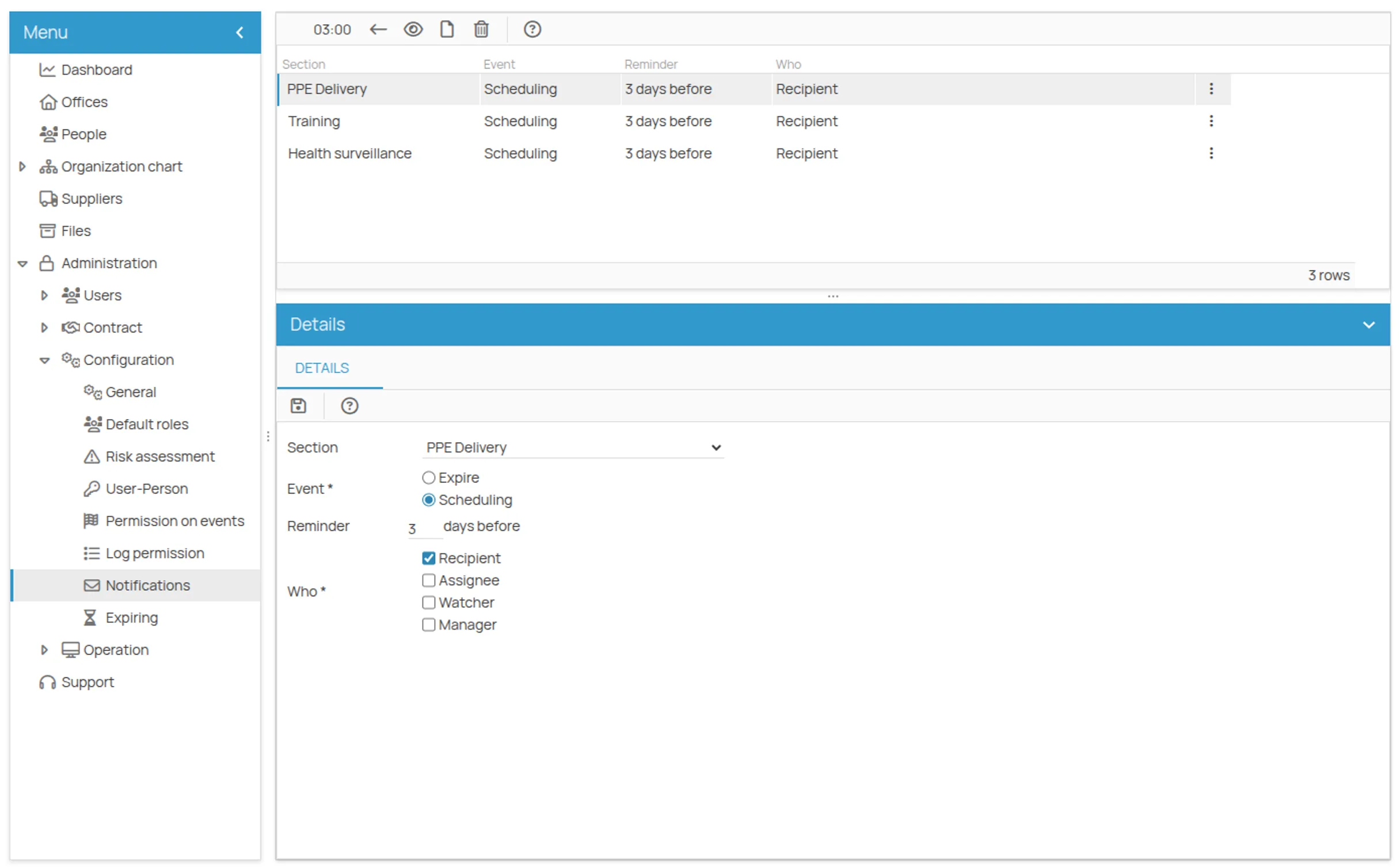
- Timely and recurring notifications: activate alerts for deadlines, assigned actions, and schedules.
- Share documentation in real-time: procedures, manuals, operating instructions, and DVR; ensure that published versions are tracked and that the notification reaches the correct recipients.
- Engage suppliers and external staff: send operating instructions, documentation requests, and reminders; share risk assessments finalized for the drafting of the DUVRI.
- Communicate directly with workers: inform company personnel regarding deadlines and schedules for all personal preventive activities.
- Schedule periodic digests and agendas: send reports and summaries to relevant functions (daily/weekly/monthly) with content adapted to the role.
- Timely and recurring notifications: activate alerts for deadlines, assigned actions, and schedules.
- Share documentation in real-time: procedures, manuals, operating instructions, and DVR; ensure that published versions are tracked and that the notification reaches the correct recipients.
- Engage suppliers and external staff: send operating instructions, documentation requests, and reminders; share risk assessments finalized for the drafting of the DUVRI.
- Communicate directly with workers: inform company personnel regarding deadlines and schedules for all personal preventive activities.
-
Communication and Accountability: Added Value
At the end of the process, you will have a tailored communication system built on company needs and capable of involving all internal and external players.
The system offers: granular profiling and formalized HSE organization chart; configurable notifications and digests; App for mobility and evidence collection; system logs and reports for verifications and audits; tools to involve suppliers and external collaborators.
All this enables immediately measurable governance and provides company management with evidence ready for audits, inspections, and strategic decisions.At the end of the process, you will have a tailored communication system built on company needs and capable of involving all internal and external players.
The system offers: granular profiling and formalized HSE organization chart; configurable notifications and digests; App for mobility and evidence collection; system logs and reports for verifications and audits; tools to involve suppliers and external collaborators.
All this enables immediately measurable governance and provides company management with evidence ready for audits, inspections, and strategic decisions.
Key Features
Tools for defining responsibilities, granular access profiling, and managing communication flows to all stakeholders.
- Custom Permissions and Roles
-
Granular management of access rights to control who can view, edit, or add data, ensuring security and confidentiality.
- User Management
-
Creation of profiles with individual logins and structured assignment of projects, sites, and roles for centralized and effective governance.
- Recipient Types
-
Selection of dynamic and contextual recipients for notifications, using custom roles or assignments to ensure timely communication.
- Company Management
-
Configuration of multiple corporate entities in a single system with separate data and documents, ideal for complex groups or professional firms.
- Customizable Notifications
-
Definition of rules for automatically sending alerts to the correct recipients based on events or deadlines.
- Operational Company Roles
-
Mapping of job roles and responsibilities to precisely track activities performed and regulatory obligations associated with each profile.

Request a demo
Discover how 4HSE works with a guided demo or an informative call with one of our consultants.