Event Management and Reporting
Immediate reporting via App and full management of near-misses, incidents, and injuries. Transformation of every event into traceable corrective actions with KPI dashboards, automated workflows, and full regulatory compliance.
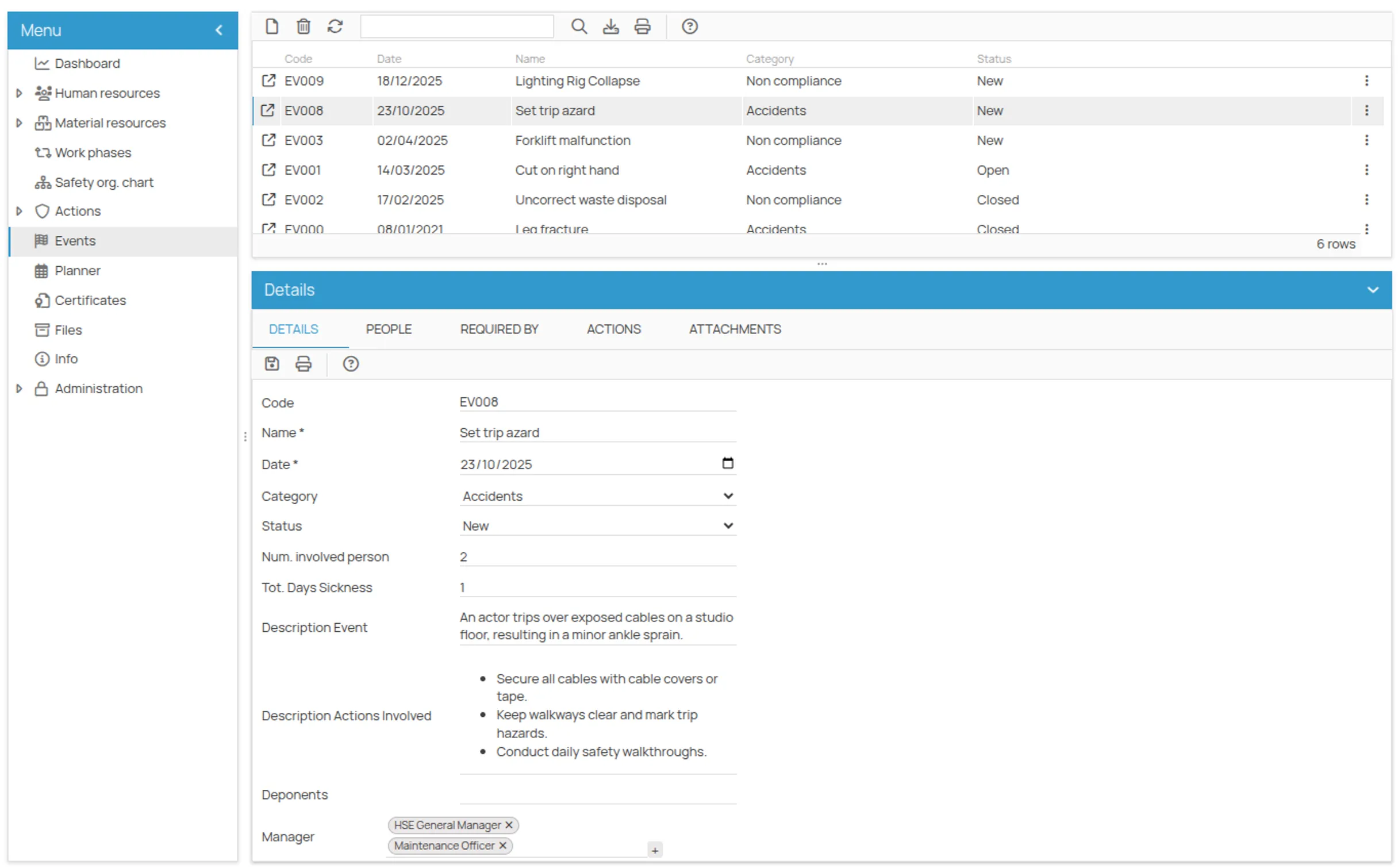
- Efficient Event Management
- Immediate reporting via mobile and desktop App, structured workflows, and quick actions reduce response times and economic impacts, lowering the TCO of event management.
- Greater Regulatory Compliance
- Full traceability, digital evidence, and standardized reports simplify inspections and reduce the risk of penalties.
- Operational Optimization
- Guided processes, targeted notifications, and integration with the scheduler transform reports into executed actions, without friction.
- Strategic Value of Data
- Aggregate analysis and executive dashboards transform events into preventive insights, supporting business decisions and targeted safety investments.
The operational sequence
The 4HSE Event Management and Reporting process converts every occurrence — from non-conformity to near-miss to injury — into a tracked, measurable, and closed operational path. It offers dashboards for monitoring KPIs and measuring incidence and trends, collection of documentary evidence, photographs, surveys, and attachments, ensuring full documentation maintenance and responsibility traceability for audit-proof accountability. The platform includes a mobile App for field data collection, sharing of multimedia evidence, and data integration that keeps the system updated in real-time, ensuring process transparency and encouraging workforce involvement and collaboration.
-
Reporting and Data Collection
- Choose your preferred reporting interface: Web or App.
- Classify the event by type (near-miss, incident, quasi-incident).
- Complete the form with the required information and add evidence by attaching photos, videos, and documents.
- Choose your preferred reporting interface: Web or App.
- Classify the event by type (near-miss, incident, quasi-incident).
- Complete the form with the required information and add evidence by attaching photos, videos, and documents.
-
Classification, Communications, and Investigation
- Involve relevant functions with automatic notifications.
- Workflows and escalations are supported by the dynamic status of the event.
- Record structured metadata: location, date, people and resources involved, impact on existing preventive actions, injury days, and witnesses.
- Involve relevant functions with automatic notifications.
- Workflows and escalations are supported by the dynamic status of the event.
- Record structured metadata: location, date, people and resources involved, impact on existing preventive actions, injury days, and witnesses.
-
Corrective Plan, Containment Measures, and Preventive Actions
- Analyze events to plan preventive interventions and update documentation.
- Transform evidence and causes into an operational plan with corrective and preventive actions resulting from the investigation.
- Get automatic suggestions for populating the scheduler for individual workers based on their professional context.
- Analyze events to plan preventive interventions and update documentation.
- Transform evidence and causes into an operational plan with corrective and preventive actions resulting from the investigation.
- Get automatic suggestions for populating the scheduler for individual workers based on their professional context.
-
Monitoring, Reporting, and Closure
- Ensure effective closure and verify continuous organizational learning.
- Measure reaction effectiveness by monitoring KPIs with real-time updated dashboards for data-driven decisions.
- Use reporting for inspections, audits, and communications to demonstrate regulatory compliance.
- Ensure effective closure and verify continuous organizational learning.
- Measure reaction effectiveness by monitoring KPIs with real-time updated dashboards for data-driven decisions.
- Use reporting for inspections, audits, and communications to demonstrate regulatory compliance.
-
The Complete Event Management Process
The 4HSE approach combines reporting simplicity with investigative rigor and governance: every event becomes a tracked, analyzed information asset converted into executed preventive actions. The result is a reduction in operational and regulatory risk, greater efficiency in emergency management, and a wealth of data usable for strategic decisions. Full integration with the Mobile App, DVR, and scheduler ensures that the entire cycle — from reporting to closure — is measurable, repeatable, and ready for audits and reporting.The 4HSE approach combines reporting simplicity with investigative rigor and governance: every event becomes a tracked, analyzed information asset converted into executed preventive actions. The result is a reduction in operational and regulatory risk, greater efficiency in emergency management, and a wealth of data usable for strategic decisions. Full integration with the Mobile App, DVR, and scheduler ensures that the entire cycle — from reporting to closure — is measurable, repeatable, and ready for audits and reporting.
Key Features
Integrated systems for immediate reporting and traceability of corrective plans.
- Reporting
-
Enables communication of non-conformities and incidents by authorized users.
- Workplace Injuries
-
Detailed recording of data, dynamics, causes of injury events, and corrective actions.
- Non-Conformities
-
Management of detected NCs and subsequent corrective actions.
- Risk Treatment Plan
-
Definition of concrete activities, timelines, and responsibilities for resolving critical issues.
- Recipient Types
-
Management of contextual notifications based on roles and assignments to ensure correct information dissemination to involved stakeholders.
- HSE Audit
-
Planning, management, and documentation of HSE audits to ensure regulatory compliance and continuous improvement.

Request a demo
Discover how 4HSE works with a guided demo or an informative call with one of our consultants.