
Near miss is a term that comes up more and more in workplace safety conversations, often without a clear explanation. It refers to an unplanned event in which something went wrong, but without causing harm.
What might seem like an episode to file away with relief is actually a signal: it indicates that in that specific context, with those tasks and that equipment, a real vulnerability exists.
Understanding what near misses are and how to manage them has become relevant not only for HSE professionals, but for anyone in an organisation with responsibility for worker safety.
Why near misses matter for prevention
The key reference model is the injury pyramid, developed in the 1930s by researcher Herbert Heinrich. According to this model, every serious injury is preceded by a larger number of minor incidents and an even greater number of near misses.
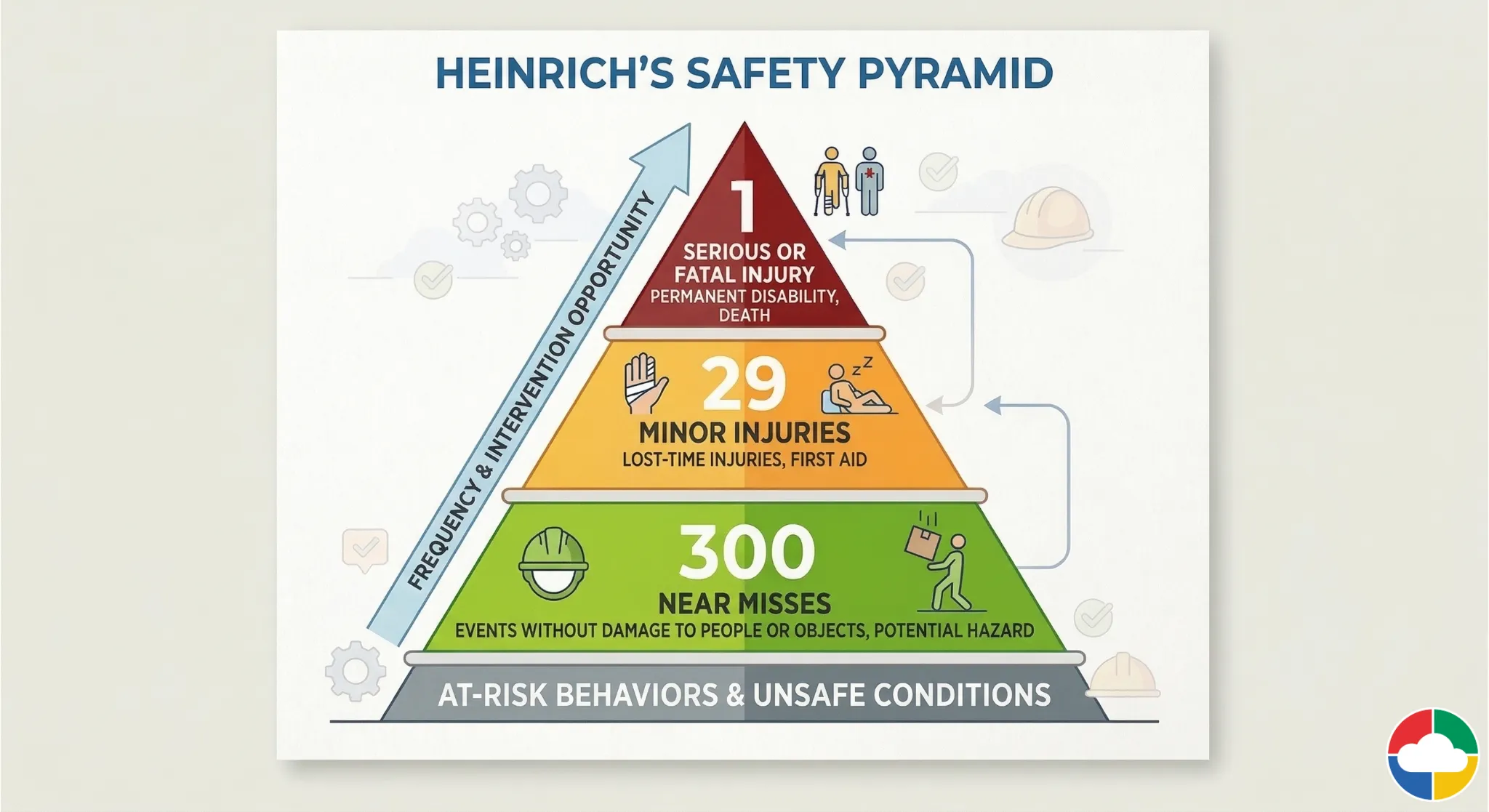
The exact proportions have been debated among researchers over the years, but the underlying principle holds: serious events do not happen in isolation. They emerge from a pattern of smaller signals that usually go unnoticed.
Working on near misses means getting ahead of the problem rather than managing its consequences — the difference between a reactive approach and a proactive one.
A shifting regulatory landscape
Across Europe and beyond, regulators are moving in the same direction: near miss management is increasingly treated as a structured obligation rather than an optional best practice. Organisations are expected to collect reports, investigate root causes and document the preventive actions taken.
The underlying expectation is consistent: having a procedure on paper is not enough. When inspected, companies need to demonstrate that the system actually works.
How to manage near misses with 4HSE
The platform 4HSE supports near miss management through a mobile application and an integrated workflow covering three key moments:
1. Reporting The worker who witnesses or experiences a near miss reports it directly through the app, describing the event, indicating the location and attaching photographic evidence if available. The process is simple and accessible, so it is ready to use when it matters.
2. Root cause analysis Once a report is submitted, the relevant safety managers receive an automatic notification and can access the event from the desktop platform. The goal is to understand why the situation occurred — a training gap, a maintenance issue, an organisational problem or inadequate equipment. The analysis turns a near miss from an isolated episode into a useful data point.
3. Preventive action and documentation The cycle closes with concrete measures to reduce or eliminate the identified risk. Every report, analysis and action is tracked within the platform, building a searchable record that meets the documentation requirements increasingly expected by regulatory bodies across different jurisdictions.
A tool for participatory safety
Managing near misses is increasingly a regulatory requirement, but treating it only as such means overlooking its most valuable aspect: a system where workers report, managers analyse and measures are actually adopted stops being a passive data collection exercise and becomes active risk monitoring.
Regulatory compliance, in this sense, can become the starting point for building something more solid: a workplace where safety is driven from within.